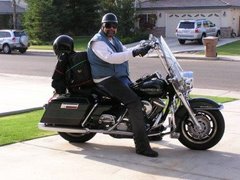
I wanted to take advantage of the great weather we are having here is Central California, so I jumped on the Road King and headed up the road 40 or so miles to Porterville.
Porterville is located in the foothills of the Sierra Nevada mountains.
 John Colver and his North American Texan T-6
 The North American T-6 Texan was known as "the pilot maker" because of its important role in preparing pilots for combat.
 In all, more than 17,000 airframes were designed to the Texan standards.
 Today, over 350 T-6 Texans remain in airworthy condition.

 North American AT-6F Texan
 Here is a close up view showing all of the races that the plane has been in and how it has finished.
 For a few bucks you could take a ride in this bi-plane.

 Some airplane's were air worthy...

 ...and some were not!
 Cal Fire / CDF S-2F water drop.
 The S-2F is one of the most cost effective and maneuverable fire fighting aircraft.
 It's small size and turbo-prop engines allow it to operate from airfields ranging from commercial to small municipal runways. The S-2F can maneuver and fly slow enough to make accurate drops where the larger tankers can't safely navigate.
 Cal-Fire OV-10 Bronco Forward Air Control
 The Cal-Fire OV-10 Bronco was originally a turboprop light attack and observation aircraft. Built by North American Rockwell in the 1960s as a special aircraft for military COunter INsurgency(COIN) combat, its primary mission was designated as a Forward Air Control (FAC) aircraft. The canopy design offers excellent visibility, a very important feature when it came to CDF/Cal-Fire upgrading from the old Cessna O-2 Skymasters.
 1958 Beech J35

 Frank Donnelly in his clipped wing Taylorcraft.
Donnelly’s Taylorcraft, N6588C, was originally flown in the Southeast, where it was eventually underwent a Swick conversion that turned the humble taildragger into a more mighty aerobatic mount. N6588C has shorter wings (clipped-wing conversion), one seat rather than the original two seats; larger control surfaces; 120-hp Lycoming engine rather than the stock 65-hp Continental.
 The pilot reported after a few maneuvers that he was experiencing control problems and that he would be ending the performance early.
 After landing, he ended up going off the side of the runway flipping the plane, ending upside down. It was reported the pilot sustained no injuries.
Had a nice leisure ride home through the orange groves and olive orchards.
Until next time, keep the rubber side down and the shiny side up!